(239) 413‑6205
Driveway Comparison Guide

Concrete Driveway vs Pavers in Southwest Florida: Which Is Better?

Choosing a concrete driveway vs pavers in Southwest Florida comes down to more than appearance. Concrete usually gives you a continuous surface, a straightforward construction sequence, and a practical path to a site-specific quote. Pavers offer more pattern flexibility and can make localized surface repairs easier because individual units can be removed and reset.

Neither material is automatically the better driveway. Base preparation, drainage, edge conditions, vehicle loads, workmanship, maintenance expectations, and the City review process can matter more than the surface alone. For Cape Coral properties, the right decision starts with the actual site, not a national price chart.

Reviewed by Yary Rabeiro, CEO

Illustrative editorial image: not Rabeiro project proof.

Quick Answer: Concrete or Pavers?

Concrete is often the stronger fit when your priorities are a clean continuous surface, simpler finish choices, and a concrete contractor who can coordinate removal, preparation, drainage, placement, joints, curing, and final review under one scope.

Pavers are often worth comparing when pattern, color variation, or the ability to lift and reset individual units matters more to you. A paver driveway is still a built pavement system. It depends on excavation, a stable base, bedding material, joint sand, edge restraint, grade, drainage, and careful installation.

For many owners, the concrete driveway vs pavers decision becomes clearer when the visible surface is treated as one part of the complete installed system. The most useful question is not, "Which material is always best?" It is, "Which installed system fits this property, this budget, and the amount of maintenance I am willing to manage?"

If you are leaning toward concrete, review Rabeiro Construction Group's concrete driveway installation in Cape Coral or request a site-specific driveway estimate.
Concrete Driveway vs Pavers: Side-by-Side Comparison

This table is a decision guide, not a specification or price promise. The right driveway assembly must be based on the property, expected use, approved scope, and current local requirements.

Decision factor Poured concrete driveway Interlocking concrete pavers
Initial proposal Often presents a lower starting quote than a comparable quality paver system, but demolition, base work, drainage, finish, and access can change the total Often includes more individual material, layout, cutting, edge, bedding, and joint work; actual proposals vary by product and pattern
Appearance Continuous surface with broom, color, scoring, exposed aggregate, stamped, border, or other approved finish options Individual units with multiple colors, shapes, laying patterns, and border combinations
Movement Control joints help manage where normal concrete shrinkage cracks are likely to form; no contractor should promise a permanently crack-free slab Units can move independently, but settlement, spreading, faulting, joint loss, or uneven areas can occur when the base, edges, drainage, or joints fail
Localized repair A patch or replaced panel may remain visible; widespread base or grade failure can require section or full replacement Individual units can often be lifted and reset, but the underlying cause must still be corrected
Regular upkeep Cleaning, stain response, joint and crack observation, and optional sealing when appropriate Cleaning, joint-sand monitoring, weed or ant control, edge checks, resetting where needed, and optional sealing
Drainage & permitting Grade, swale, ramp, culvert, right-of-way transition, and approved finish must work with the property and City process Standard pavers are not automatically permeable or permit-exempt; the same site, drainage, right-of-way, and finish questions still matter
Access after installation Concrete needs a project-specific curing and vehicle-access plan Pavers do not use a concrete slab curing period, but installation, compaction, joint filling, stabilization, and inspections still affect access

Concrete Driveway Cost vs Pavers: What Changes the Price?

Pavers often receive a higher initial quote than a comparable poured concrete driveway, but that is not a rule for every property. A small simple driveway, a large demolition project, a complex pattern, difficult equipment access, or major drainage work can change the comparison.

Ask both bidders to define the same cost factors:

  • Existing driveway removal, hauling, and disposal
  • Excavation and unsuitable-material removal
  • Base material, preparation, and compaction
  • Driveway dimensions, shape, curves, and transitions
  • Right-of-way, swale, ramp, culvert, and drainage work
  • Concrete specification and finish, or paver product and pattern
  • Reinforcement, control joints, bedding, joint material, and edge restraint as applicable
  • Utility conflicts, roots, irrigation, and limited access
  • Permit, plan, inspection, and closeout responsibilities
  • Cleaning, sealing, repair, and maintenance expectations after installation

A low proposal can become expensive if it leaves out demolition, base correction, drainage, edge restraint, finish details, inspections, or cleanup. Compare written scope before comparing the bottom-line number.

Which Driveway Handles Southwest Florida Conditions Better?

Both systems can perform well in Southwest Florida when the design and installation fit the site. Both can also show distress when water, weak support, poor transitions, roots, concentrated loads, or incomplete preparation are ignored.

How concrete responds

A poured concrete driveway acts as a connected slab system. Base preparation helps distribute loads, while control joints create planned locations for normal shrinkage movement. Concrete can still crack. The goal is responsible preparation, practical panel geometry, appropriate jointing, controlled placement, curing, and honest expectations, not a crack-free guarantee.

Settlement or drainage problems can affect a large section because the surface is continuous. A localized patch may function, but it may not match the older concrete in color or texture.

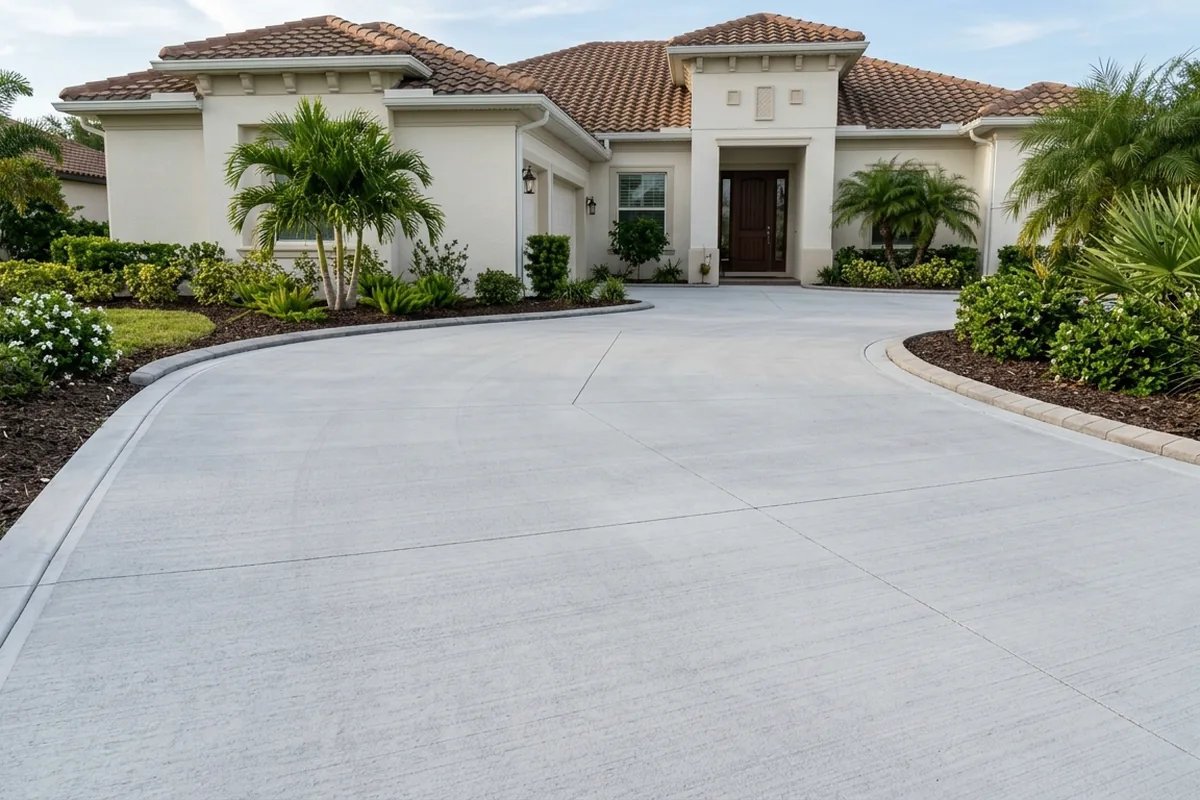
Illustrative concrete driveway control joints in a Southwest Florida residential setting
Illustrative editorial image: not a verified Rabeiro project photograph.

How pavers respond

Interlocking pavers transfer loads through the units, joints, bedding, base, and edge restraint. Individual pavers can often be removed and reinstated, which is useful when a small area needs access or correction.

That repair advantage does not eliminate underlying problems. A saturated or poorly compacted base, lost joint sand, weak edge restraint, settlement, or concentrated runoff can lead to wider joints, uneven units, rotation, or depressions. Resetting the surface without fixing the cause can allow the problem to return.

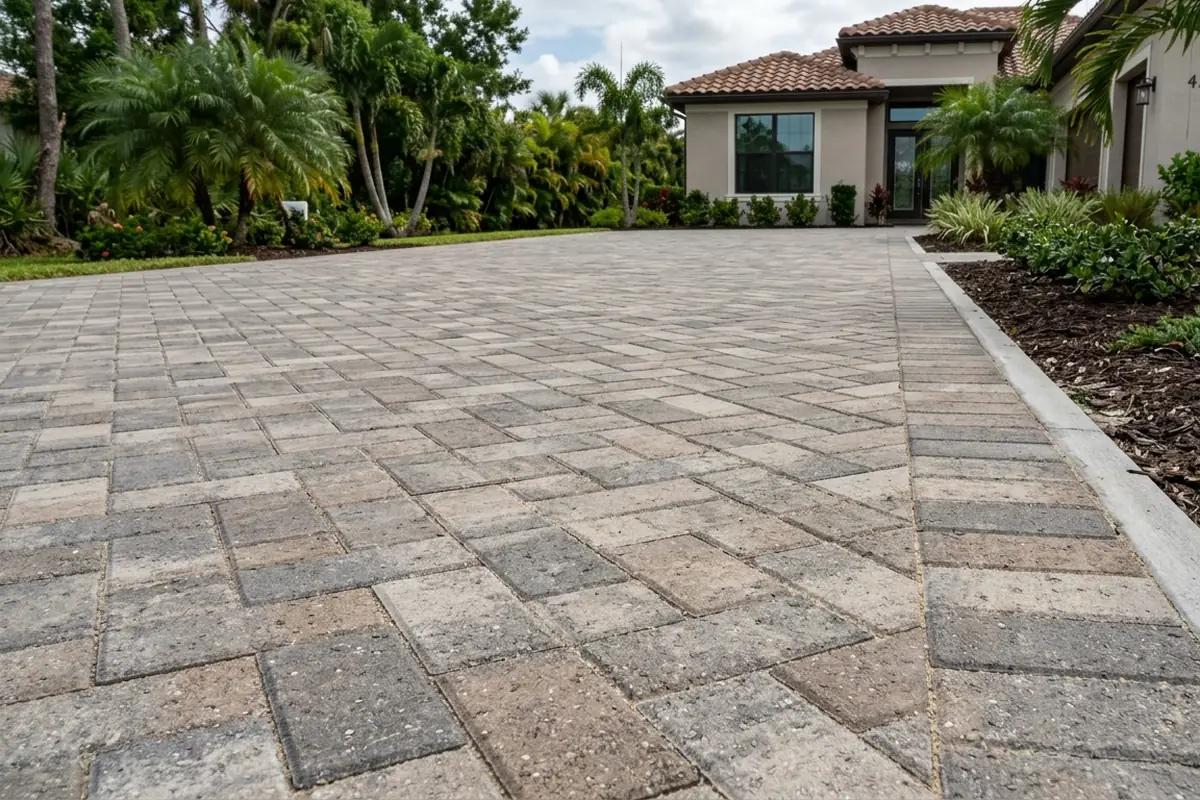
Illustrative interlocking paver driveway joints and edge-restraint detail
Illustrative editorial image: not a verified property or Rabeiro installation.

Maintenance: What Will You Need to Do?

The best driveway is one you are willing to maintain. Neither concrete nor pavers should be treated as a surface you can ignore forever.

Concrete driveway maintenance

Concrete ownership may include routine cleaning, timely stain treatment, observing joints and cracks, protecting edges from unusual loads, and discussing sealing when it is appropriate for the finish and exposure. If a crack changes quickly, shows vertical displacement, follows settlement, or appears with a drainage problem, the cause should be evaluated before a cosmetic repair is selected.

Paver driveway maintenance

Paver ownership may include sweeping, cleaning, monitoring joint-sand levels, controlling vegetation or ants in joints, checking edge restraint, and resetting localized units when needed. The Concrete Masonry and Hardscapes Association notes that joint sand, edge restraint, settlement, and drainage conditions are part of paver maintenance and repair. Sealing can help with appearance, stain response, or joint stabilization in some systems, but it is not automatically required for every paver driveway.

When comparing pavers vs concrete, ask each contractor for a written maintenance plan. A material that looks attractive on installation day may not match your expectations if the upkeep is never discussed.

Repairability: Individual Units vs a Continuous Slab

Pavers have a clear localized-repair advantage when individual units can be lifted, the underlying area corrected, and the same or matching units reinstated. This can also help when a utility repair requires access through a limited area.

Concrete repair decisions depend on the cause and the slab layout. A small surface defect is different from settlement, poor drainage, base failure, root pressure, or movement across several panels. A partial concrete replacement can work when the damaged area can be separated at practical joints and the surrounding driveway remains stable. The repaired area may still look different.

The important step for either system is diagnosis. Repair the failed support, drainage path, edge, joint, or load condition when that is the cause. Replacing only the visible surface can hide a problem without solving it.

Appearance, Finish, and Curb Appeal

Pavers offer the widest range of individual colors, shapes, borders, and laying patterns. That flexibility can suit homes where the driveway is a major design feature. Owners should view actual samples outdoors and ask how replacement units will be matched later.

Concrete can be simple or decorative. A broom finish supports a clean, practical appearance. Color, exposed aggregate, scoring, borders, and stamped options may also be considered when they fit the scope and maintenance plan. A stamped concrete driveway vs pavers comparison should include future repair appearance, not just the initial pattern.

Finish decisions need to happen before construction. Decorative details affect materials, labor, form layout, placement sequence, cleaning, sealing, and how later repairs may look.

Can You Use a Concrete Driveway With Paver Edging?

A concrete driveway with paver edging can combine a continuous center surface with a decorative border. It can be an attractive option when the transition, edge support, elevations, drainage, materials, and maintenance responsibilities are designed as one assembly.

Do not treat the paver border as decoration that can simply be added after the main scope is decided. The concrete edge, paver base, restraint, joint, height, and runoff path need to work together. The site plan and permit documents should identify the proposed finishing materials where required.

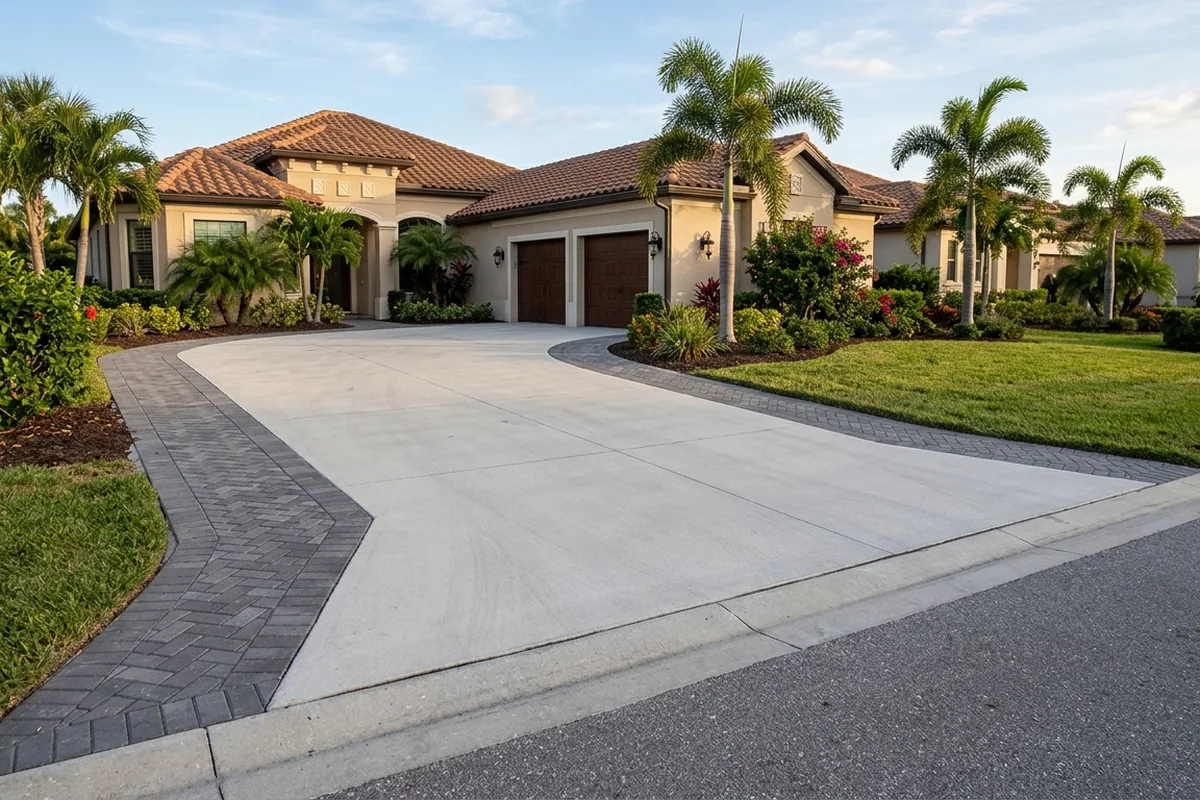
Illustrative concrete driveway with contrasting paver edging
Illustrative editorial image: material-combination concept, not Rabeiro project proof.

Rabeiro Construction Group can evaluate and price the concrete driveway scope. If a project includes specialty paver supply or installation, the written proposal should identify who is responsible for that work and how the two systems will be coordinated.

Drainage and Driveway Permits in Cape Coral

Material choice does not remove the need to plan drainage. In Cape Coral, the driveway may connect through a swale, ramp, or culvert condition inside the public right-of-way. The City of Cape Coral says its Surface Water Management program reviews driveway construction and related drainage work to protect swale function, adjacent properties, roadways, and public infrastructure.

The current City guidance says a permit is required for driveway additions or replacements within the public right-of-way. The residential driveway packet asks for existing and proposed dimensions, proposed width in the right-of-way, the finishing material, scope, and relevant site and stormwater features. It specifically recognizes work such as replacing concrete with pavers.

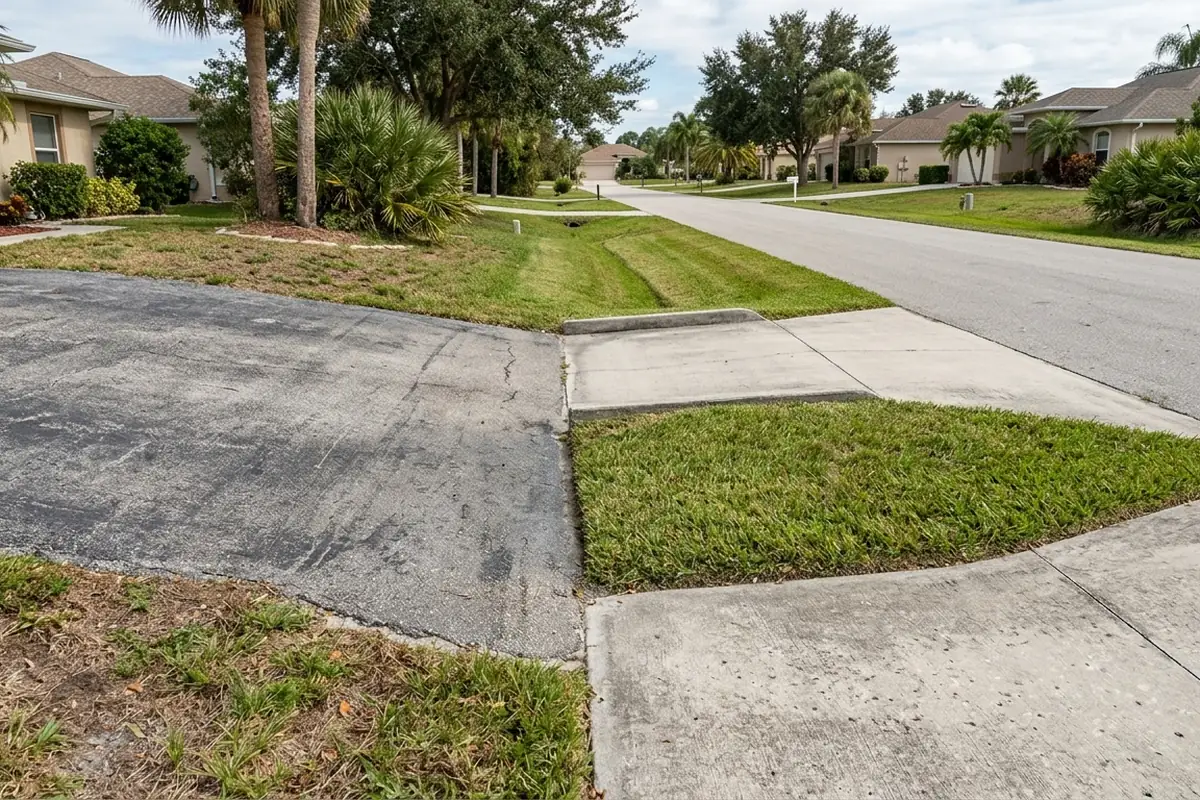
Illustrative driveway transition beside a Southwest Florida roadside swale
Illustrative editorial image: not a documented Cape Coral location or permit record.

That means pavers are not automatically permit-free, and standard pavers are not automatically a permeable drainage system. Confirm the current City process for the exact property and scope before demolition, widening, replacement, or material conversion begins.

For current information, review the City of Cape Coral Surface Water Management driveway guidance.

When a Concrete Driveway May Be the Better Fit

Concrete may be the better fit when:

  • You want a continuous surface with a clean, consistent appearance
  • A practical broom or approved decorative finish meets your design goal
  • You prefer a simpler regular-maintenance routine
  • Your contractor can coordinate removal, preparation, drainage, placement, joints, curing, and inspections in one defined concrete scope
  • You understand that normal shrinkage movement and cracking risk must be managed, not denied
  • A site-specific concrete proposal fits your budget and long-term plans

When a Paver Driveway May Be the Better Fit

Pavers may be the better fit when:

  • Pattern, color, border, and unit-level design flexibility are top priorities
  • You value the ability to lift and reset localized units
  • You are comfortable monitoring joints, sand, edges, weeds, ants, and settlement
  • A qualified paver installer provides a complete base, bedding, edge, drainage, and maintenance scope
  • The actual product, pattern, finish, and total proposal fit your property

Rabeiro's role in this article is to help owners understand the concrete option honestly. The company should not imply that it installs paver systems unless that capability and responsibility are separately verified.

Seven Questions to Ask Before Choosing

  1. Priority balance: What matters most: initial budget, design flexibility, localized repair, low routine upkeep, or a continuous surface?
  2. Existing conditions: What are the existing grade, drainage, swale, culvert, base, root, and right-of-way conditions?
  3. Scope parity: Does each proposal include the same demolition, disposal, dimensions, preparation, finish, permit, inspection, and cleanup responsibilities?
  4. Maintenance expectations: What maintenance does the contractor recommend during the first year and over normal ownership?
  5. Edge & load handling: How will the system handle edges, garage transitions, walkways, street access, and concentrated vehicle loads?
  6. Repair appearance: What will a future repair look like, and are matching materials likely to be available?
  7. Contract allocation: Who is responsible for permits, changed conditions, final access instructions, and closeout?

Bring the same questions to every contractor. A clear scope is more useful than a material sales pitch.

Frequently Asked Questions About Concrete Driveways vs Pavers in Florida

Common questions from Southwest Florida homeowners regarding driveway costs, durability, maintenance, permits, and overlays.

Are pavers more expensive than a concrete driveway?

Pavers often receive a higher initial quote because the system can involve more individual material, layout, cutting, bedding, joint, and edge work. Concrete is not automatically cheaper on every property. Demolition, access, base correction, drainage, finish, shape, and right-of-way work can change either proposal. Compare the same complete scope rather than a national cost per square foot.

Which lasts longer, concrete or pavers?

There is no responsible universal answer for every driveway. Base preparation, drainage, product or concrete specification, edge support, joints, installation quality, traffic, roots, maintenance, and repairs affect service life. Be cautious with any exact lifespan claim that is not tied to the actual system and site.

Do pavers crack?

Individual pavers can chip, crack, or spall, although damaged units may be replaceable. Paver systems can also settle, spread, rotate, or become uneven when joints, edges, bedding, base, drainage, or underlying soil conditions fail. Pavers change the repair method; they do not eliminate every pavement problem.

Will a concrete driveway crack?

Concrete naturally shrinks and moves, so no contractor should promise a permanently crack-free driveway. Proper preparation, practical slab layout, joints, placement, and curing help control risk and encourage movement to occur at planned locations. Settlement, roots, heavy loads, drainage, and other site conditions can still cause cracks or movement.

Are driveway pavers automatically permeable?

No. Standard interlocking pavers are not automatically a permeable pavement system. Permeable systems use a specific unit, joint, bedding, base, drainage, and maintenance design. Ask the designer or installer to identify the exact system and confirm how it fits the current City process.

Can pavers be installed over an existing concrete driveway?

An overlay may be possible in a specifically evaluated system, but it is not a universal shortcut. The existing slab condition, movement, elevations, garage and street transitions, drainage, added height, edges, and permit scope need review. Covering a failed or poorly drained slab can carry the underlying problem into the new surface.

Do I need a Cape Coral permit to replace concrete with pavers?

The current Cape Coral driveway packet identifies replacement of concrete with pavers as driveway work and asks applicants to show the scope, dimensions, finishing material, and relevant site features. The City states that additions or replacements within the public right-of-way require a permit. Confirm the current requirements for the exact property before work begins.

Get a Site-Specific Concrete Driveway Estimate

The right concrete driveway vs pavers decision should leave you with a surface that fits the property, the City process, your maintenance expectations, and your budget. If concrete is the leading option, Rabeiro Construction Group can review the existing surface, access, visible drainage conditions, proposed layout, finish goals, and concrete scope for a written estimate.

Review concrete driveway services in Cape Coral or request your driveway estimate. You can also call (239) 413-6205.

Rabeiro Construction Group LLC
2126 SE 1st Terrace, Cape Coral, FL 33990
Phone: (239) 413-6205 • Email: yary.rabeiro@rabeirocg.com

Official Sources & Citations

Regulatory and industry references consulted for driveway installation, drainage compliance, and pavement maintenance standards in Florida.

View official Cape Coral, CMHA & NRMCA references